


Cards on the table: I love coffee. It’s my favorite drink. I could write poems about it. I wouldn’t, but I could! There was a time in my life when I couldn’t survive without it. I even have a record of 1.3 liters in a single day. (I remember the sleepless night after! It wasn’t all espresso, but I’m still lucky I didn’t OD.) But, as you might guess, I’d grown dependent. So, when my neurologist told me to patiently mix it up and gradually wean myself… I quit cold turkey.
I’d tried that before. Once! And I’d failed miserably. The textbook advice, the sane advice, the advice my neurologist actually gave me, is to taper down slowly so your brain barely notices. I, being me, chose bravado. And then I paid for it.
Let’s start with why I bothered to do it at all, then the withdrawal itself, then how things shifted and where I stand now. I’ve formatted it like a step-by-step guide. The first step is always the hardest!
Why Quit Coffee at All? (i.e. Am I Insane?)
Quitting substance abuse? You’re gonna need a good reason! Coffee, like any other substance, stays in our lives because it serves a function. It pays a rent, as I like to say. It’s amazing if you find that function. That knowledge alone serves you in unseen ways.
Maybe it helps you soldier on with sleep deprivation. Maybe you believe “creativity runs on caffeine” when you just don’t have a creative system. Maybe it sharpens a mind that’s exhausted from coping with stress all the time. All of those items were true for me at one point or another!
It’s okay if you don’t really know. You may just know that you have to have it every morning or you’re doomed. (Used to be true for yours truly.) You can instead focus on what you’re going to do with a coffee-free life. Maybe you’d like to appreciate good tea. Maybe it’s just cheaper to drink less! Or maybe you like the prospect of not turning into a monster when you accidentally skip your morning cup.
I’m starting to sound dramatic, as if I’m talking about cocaine. But caffeine dependence is very real. It’s the most widely used psychoactive drug on the planet, and it acts on your brain like one. Quitting is genuinely hard.
So, it helps immensely to know why you’re putting yourself through all that misery. Find the function. Name the rent it’s paying. Then you’ll know what you’re actually giving up, and what you’re getting in return.
Speaking of misery, on to the withdrawal symptoms! Have your last cup for a while, start a streak (I used Loop Habit Tracker on Android), and brace for impact.
Surviving the Withdrawal Symptoms
Yes, “symptoms” is plural because there are a lot of them! Let’s start with caffeine’s half-life, because I thought that would be key. (I was wrong, but it’s a nice detour.)
Caffeine’s Half-Life
It turns out coffee doesn’t linger as much as I’d thought. Caffeine has a half-life of about 6 hours, meaning the amount in your body halves every six hours or so. The math goes like this:
- After 1 half-life (~6h): 50% remains
- After 2 half-lives (~12h): 25% remains
- After 3 half-lives (~18h): 12.5% remains
- After 4 half-lives (~24h): 6.25% remains
- After 5 half-lives (~30h): ~3% remains
In other words, the caffeine itself is basically gone within about 30 hours. (It’s also worth knowing that this half-life is wildly individual. A gene called CYP1A2 controls how fast your liver clears caffeine, which contributes to why your friend can have an after-dinner espresso and sleep like a baby. Pregnancy, smoking, and some medications shift the half-life too.)
But the caffeine leaving your system is not the same as your body being done with it. The substance clears in a day. Your brain’s reaction to its absence is just getting started, and it’s going to hurt for a couple of weeks. Which brings us to the headaches.
Why the Headaches? Blame Adenosine
Here’s the part nobody tells you, and it’s the part that actually explains everything.
Your brain produces a molecule called adenosine. It builds up while you’re awake, and it’s essentially your “I’m getting tired” signal. It makes you drowsy and, helpfully, it widens the blood vessels in your brain.
Caffeine works by impersonating adenosine and jamming itself into the same receptors without activating them. It blocks the tiredness signal. That’s the whole trick. Caffeine doesn’t give you energy; it just hides the fact that you’re tired.
Now, your brain hates being out-negotiated. So with daily coffee, it adapts: it grows more adenosine receptors to compensate for all the ones caffeine keeps blocking. That’s tolerance: the reason your one cup eventually became two, became a doppio, became 1.3 liters on a bad day.
Then you quit. Suddenly all those extra receptors are wide open, and there’s no caffeine to block them: just a flood of adenosine hitting far more landing pads than you had before you started. The result is a brain that’s screaming “TIRED” at full volume, and a wave of blood vessels in your head dilating all at once. That sudden rush of blood flow is, by the leading theory, exactly what your caffeine withdrawal headache is. The throbbing, the fog, the bone-deep fatigue? That’s your brain recalibrating in real time.
Again, this isn’t me being dramatic. Caffeine withdrawal is a recognized clinical condition. (It even has its own entry in the DSM-5!) Symptoms usually start 12 to 24 hours after your last cup, peak in days or weeks, then drag on for a while.
The headache is the headline act, but the supporting cast is also well documented: fatigue, irritability, low mood, trouble concentrating, and even flu-like aches and nausea. Knowing that it’s a finite, predictable process is, honestly, half the battle.
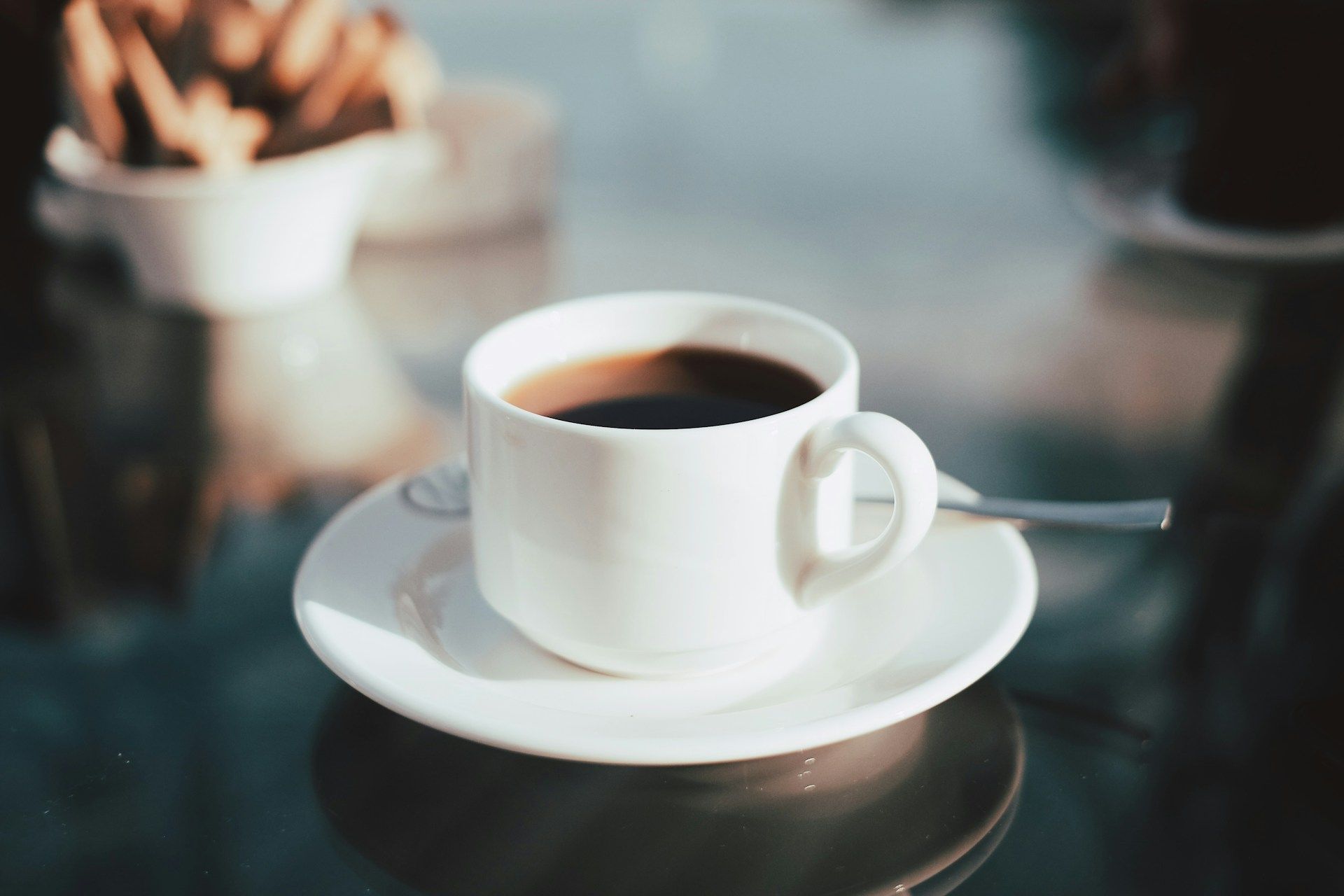
Other Withdrawal Symptoms
I treated this thing as substance abuse and I was right! The symptoms were horrible. I couldn’t get out of my bedroom for two or three days in that first wave: headaches, trouble going to the bathroom (caffeine is a colon stimulant, so quitting briefly puts the plumbing on strike), all-day fatigue, mental fog, and being cranky as a wet squirrel.
I’m fairly sure this is why all my coworkers think I’m going to be passive-aggressive the moment they so much as whisper the word “meeting.” (To be fair, video calls genuinely do drain some of us more than others, though I can’t pin all of my behavior on the no-coffee experiment, much as I’d like to.)
The mean trick is the timing: the symptoms peak right around when you’re most tempted to cave, because one cup would make all of it vanish in twenty minutes. That’s the trap. Push through the peak and the curve starts bending in your favor. For me, the peak was around two weeks in.
Relaxing Into the Reset
The body resets eventually, and it’s just good. Once the caffeine’s been gone a while, your brain quietly dismantles all those extra adenosine receptors it built and settles back to baseline.
The drowsiness lifts not because you’ve found a new stimulant, but because there’s nothing left to withdraw from. (That was the case for me, of course. If you smoke or drink too much alcohol, that’s a different story.) This reset usually takes a couple of weeks, and it’s the moment the whole thing stops being a slog and starts being interesting.
Because here’s what you gain: you finally start hearing the signals your body was sending all along. Always wanting to nap at 3 PM? When coffee was masking it, that just felt like “normal life.” Without the mask, it reads loud and clear: maybe you’re sleep-deprived and your lifestyle needs to change. Maybe it’s something a doctor should look at. The point isn’t that the nap craving is good or bad. The point is that now you can actually hear it, instead of papering over it with another cup.
That reframe stuck with me more than anything else. Coffee wasn’t an energy source I’d lost. It was a volume knob on my own exhaustion, and turning it down let me hear how tired I’d actually been.
Teas & Other Drinks
I truly didn’t understand what people saw in tea. I have a friend who’d drink herbal tea at our get-togethers and I used to give him grief about it constantly. (Sorry, Morty!) But with coffee gone, I tried a lot of new teas and herbal mixes. Out of necessity, you might say!
Don’t get me wrong, most of them were horrible. But I found a couple of new favorites, ranked roughly from “love” to “fine”:
- Green tea: I’d always liked it but only ever sipped it sporadically. This coffee break finally gave me the excuse to buy half a kilo and commit. Love it! (Bonus: it contains L-theanine, an amino acid that takes the edge off caffeine’s jitters and gives you a calmer kind of alert.)
- Good old black tea: It’s fun, and it has a little caffeine too. It’s handy if you want a gentle on-ramp rather than going fully caffeine-free.
- Yerba maté: Earthy and weird. Love it.
- Caffè d’orzo: Roasted barley, completely caffeine-free, and a genuinely new paradigm for a hot drink. Like it a lot!
- Oolong: A bit of a hassle to make properly, so it lands lower on the list. But it was good the one time I had it!
The trick with coffee alternatives is to stop trying to replace coffee and start treating these as their own thing. They’re not pretending to be espresso, and once I let them off that hook, I actually enjoyed them.
Making a Conscious Choice
I got up on the 91st day, felt as happy and refreshed as I’d been for the last couple of weeks, and made the fully conscious choice to walk straight to the coffee machine and pull myself an espresso. I had fun making it. And it was an almost embarrassingly good time drinking it.
And that’s the whole point. After ninety days, the relationship had changed. The coffee no longer paid rent in my head as a non-negotiable; it had become a guest I’d actually invited. Caffeine dependence didn’t control me anymore: I could have it, skip it, swap it for green tea, or take another break entirely, and none of those options felt like a crisis anymore.
If you decide to bring it back, that’s the version worth aiming for: coffee as a pleasure you choose, not a deficit you’re patching. Find the function it serves, decide whether you still want that trade, and drink the doppio on purpose.

TL; DR
- Coffee doesn’t give you energy. It blocks adenosine, the molecule that signals tiredness. You feel alert because the “I’m tired” message can’t get through.
- With daily use, your brain grows extra adenosine receptors (tolerance). Quitting leaves them all exposed at once, which causes the drowsiness and the caffeine withdrawal headache. (That’s a sudden rush of blood flow in the brain)
- The caffeine clears in about 30 hours (half-life ~6h, but it’s genetic, hence your espresso-at-midnight friend). The symptoms are what you should be aware of. They’re supposed to start around 12–24 hours after your last cup, but the peak for me was two weeks later.
- Withdrawal is real and clinically recognized: headache, fatigue, fog, irritability, low mood, and, yes, a brief plumbing issue.
- Have a reason. Know what function the coffee serves before you quit. It makes the misery survivable!
- The reset lets you finally hear the body signals coffee was masking. (Looking at you, 3 PM nap craving!)
- Coffee alternatives are worth a shot, too. I personally love green tea, black tea, yerba mate, caffè d’orzo, oolong.
- After the reset, drinking coffee becomes a choice. That’s the win, whether you bring it back or not.
Final Word
I’m not here to tell you to quit coffee. I literally went back to it on day 91 and I regret nothing. What ninety days bought me wasn’t sobriety from a bean; it was the difference between needing something and choosing it. That’s worth a couple of weeks of headaches.
And if you try it and crawl back on day three? That’s alright too. Now you’re one step closer to knowing the rent caffeine pays for you.