


It’s 2010 and I walk into a CD store. I tell the guy to give me a good game. No preferences, nothing in mind. He hands me Mass Effect 2. Sixteen years later I have no way to find him, which is a problem, because that was the single most important purchase of my life.
You see, I finished it. And at the end of the Suicide Mission, every member of my crew was dead. Everyone except Joker. I’d been playing a game about assembling the best team in the galaxy, and I’d walked all of them into a one-way trip, as Miranda put it.
The worst part was that I could not for the life of me tell you why. I hadn’t understood a word anyone had said to me for forty hours.
So, I decided to actually understand what they were saying.
Little did I know that this massive RPG has more than 25,000 lines of dialogue. I didn’t know that “understanding what they were saying” would take a decade and change the language I think in.
I just wanted a better ending!
It turns out that three things made massive RPGs like the Mass Effect trilogy unusually good language teachers. I know that because I lived through all three without noticing, one alien conversation at a time.
Everything I Understood Before I Understood a Word
My English at the time was A1 at best: the level where you can introduce yourself, name a few colors, and understand approximately nothing spoken at natural speed by an alien mercenary.
So, carrying a mild case of post-traumatic stress from the first playthrough, I turned on the subtitles and started paying attention.
It didn’t solve anything. What it did was change what I was paying attention to.
You don’t stop receiving information when you can’t parse a sentence; you start harvesting it from everywhere else. I couldn’t tell you what Mordin said, but I could tell he was making a decision. I couldn’t follow Jack’s rant, but her posture, volume, and the way the camera framed her made the emotional content unmistakable.
I learned to read the situation first and the language second: who wants something, who’s refusing, who’s afraid, which of the two options on the wheel is the softer one, and so on.
It was comprehension by triangulation. Tone, expression, body language, mission context, and the handful of words I actually knew, all cross-referenced into a rough guess.
And the game kept giving me feedback. Mass Effect doesn’t leave anything without consequence. A choice produces a result. A conversation changes what happens next. Even when I didn’t understand the words, I could often understand whether I’d understood the situation.
That was the first thing I was learning without realizing it: I didn’t need the language first. I needed the meaning.
1. Meaning Before Language
Nothing in this trilogy is spoken into a vacuum. Every line arrives attached to a face doing something, a room that means something, a mission whose stakes you already understand, and often a choice you personally made an hour ago.
I knew Garrus was loyal, hotheaded, and funnier than he let on before I could understand three consecutive sentences he said. I understood approximately nothing of Mordin’s thoughts out loud, but I didn’t need to know the word “genophage” to feel the gravity of it all.
Characters came through by performance, animation, and consistency. Then, knowing those characters, I could backfill the words.
The game even had a mechanic that accidentally made this process more explicit.
The Wheel Teaches Meaning Before Vocabulary
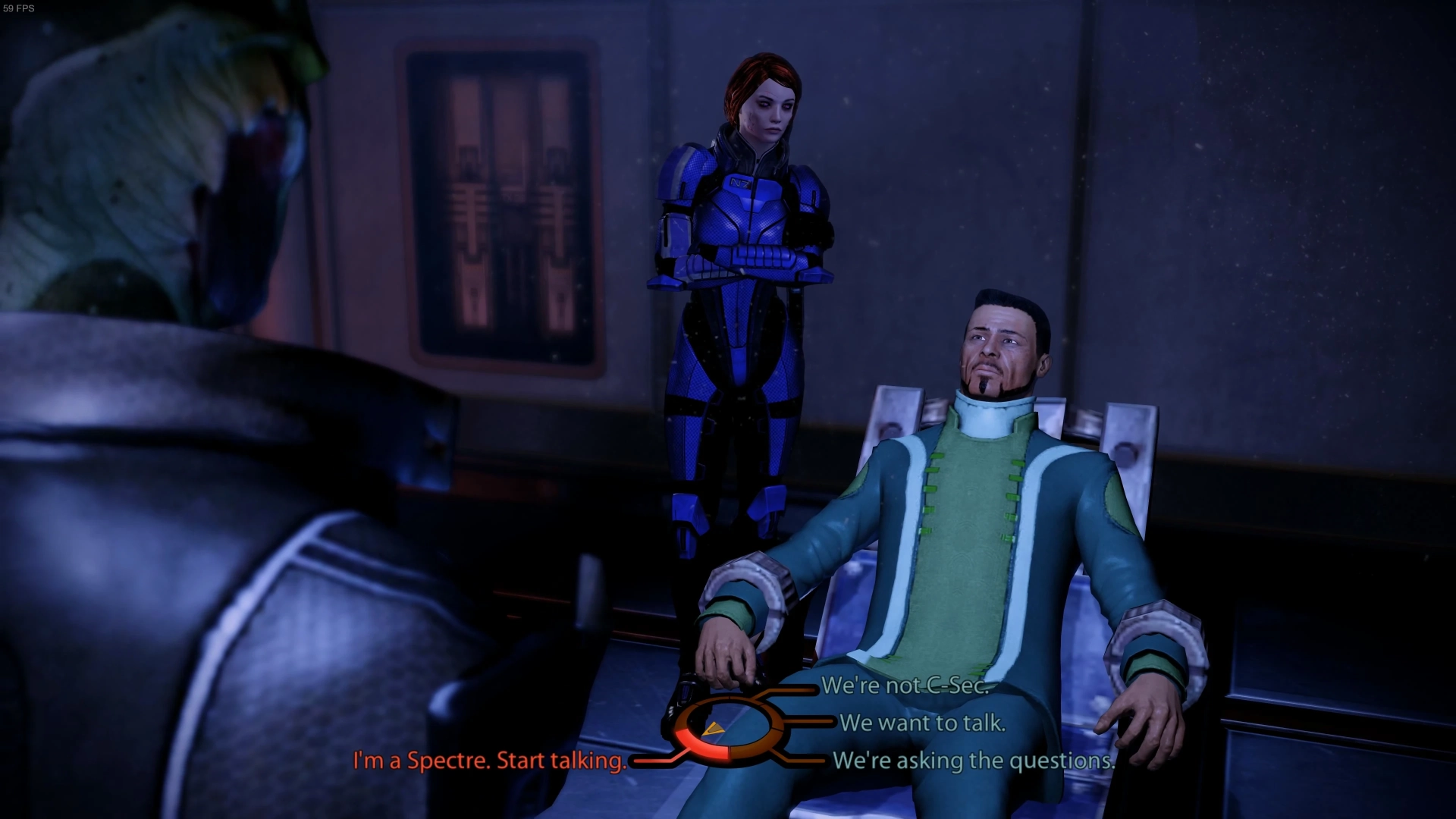
The dialogue wheel in the Mass Effect trilogy has an accidental advantage for non-native speakers. It shows you a short paraphrase of each choice: a summary of what Shepard would say. You choose one. Then Shepard says the actual line, at full length, in natural speech.
Think about what that sequence does to a learner:
- You receive the intention first, in three or four easy words.
- You commit to it.
- Then you hear how a fluent speaker turns that intention into a real sentence.
It’s an accidental pedagogical device much better than a simple translation.
A subtitle gives you the same sentence twice, once heard and once read. The wheel gives you the meaning and then the language, in that order.
To illustrate, let’s go to Jacob’s loyalty mission. In one choice, the summary says “Leave him in the hell he made.” Simple sentence, right? Relatively easy to understand. Then Shepard delivers a conditional, a subordinate clause, and an idiomatic metaphor.
For me, that gap was the whole lesson. That distance is exactly where a language lives: between intention and expression.
But meaning alone doesn’t explain why I kept coming back.
2. A Reason to Care
Context can help you understand a sentence. It can’t, by itself, make you care enough to understand the next one. Mass Effect gave me something else that language-learning materials usually struggle to manufacture: a reason to care about what I understood.
And that reason was agency.
Here’s the thing about all that context we just talked about: almost none of it was free. Aside from the opening sequences, nothing is scripted for you. You decide all of it.
Which brings us back to the Suicide Mission. It wasn’t scripted to punish me for a language gap. The punishment was a direct result of every choice I made before it. And it wasn’t a small event that happens to you in an afternoon and you forget about it after a day. It was a brutal punishment with no warning that made me feel personally responsible.
That changed the role of language completely.
I wasn’t trying to understand English because I had decided English was important. I was trying to understand it because I had people to save.
That’s what interactivity actually buys a learner: you’re not making yourself engage with an abstract world. You’re trying to understand a very real, very immersive world with stakes specific enough that you have a reason to want to understand what’s being said to you right now, because you’re the one who has to decide what happens next.
A book can be immersive, sure, but it can’t be steered. The same goes for a good movie.
And that mattered because I didn’t play Mass Effect once. The reason to understand didn’t disappear after the credits; every new playthrough gave me another reason to pay closer attention.
3. Repeated Exposure Without Studying
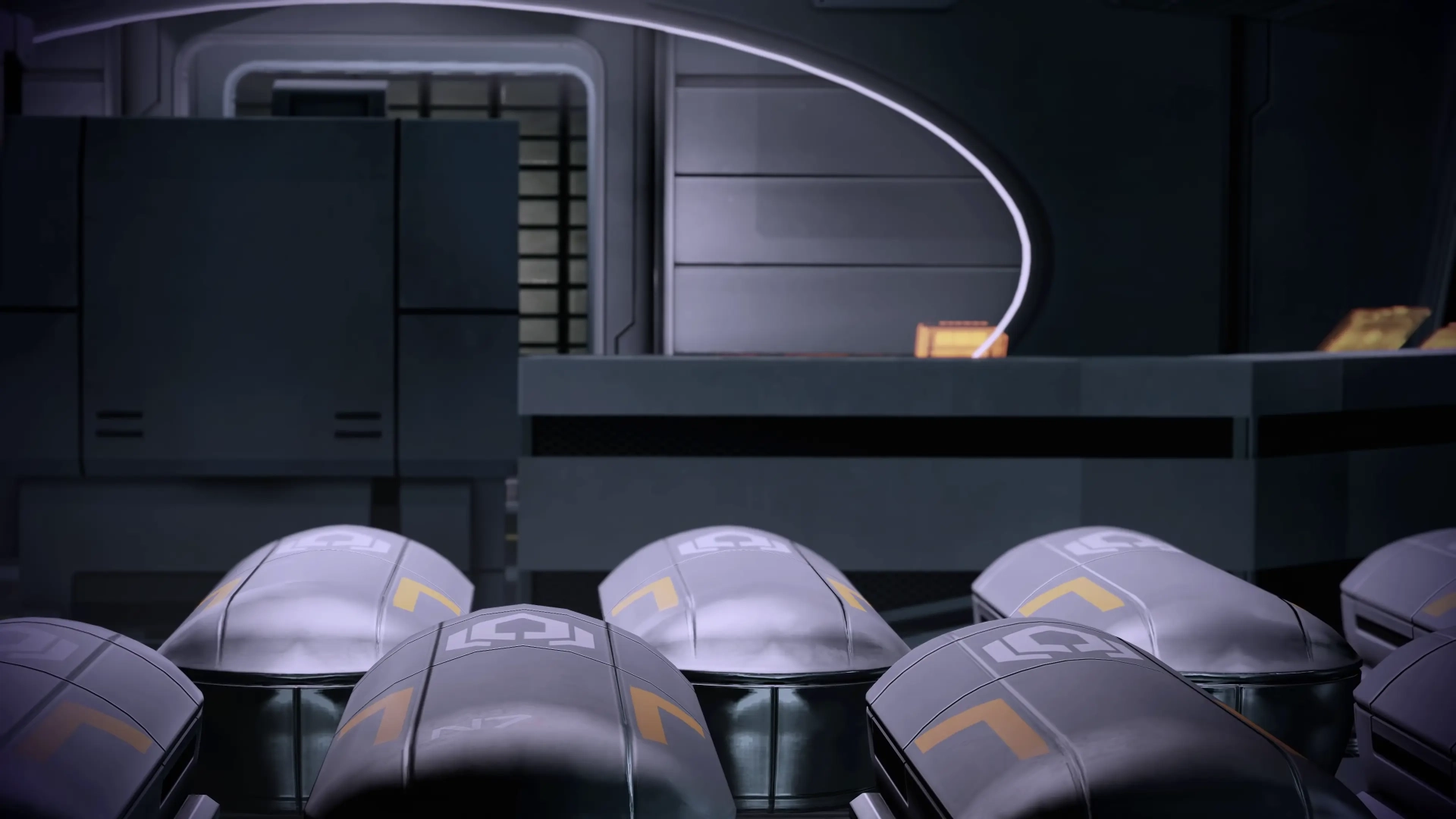
I replayed the trilogy. Then again. Eventually the number for Mass Effect 2 reached eleven, and somewhere in the middle, the language started sticking.
That’s not because repetition is magic. It’s because I knew the world a little better every time I hit “New Game.” (Small side note: the main menu sound effects for “new game” are so satisfying!)
On a first playthrough I was utterly lost in the sheer overhead of a science-fiction setting where half the nouns are invented. Plus, the gameplay and the quests were great, which really left no room for language.
On the fifth, I knew the corridor, I knew who was about to speak, I knew roughly what they’d say, why it mattered, and what would happen afterwards. All that freed capacity allowed me to have a dictionary on the side and actually look up words.
And it was roughly the same vocabulary every time, but not drilled. I wasn’t reviewing bilingual flashcards; I was living in an English-only world with a schedule.
Words were first unknown, then fuzzy, then familiar, then understood in context, and then simply understood. I wasn’t studying eleven times. I was visiting.
But there was another kind of repetition happening, too.
Mass Effect repeats itself constantly: what a mass relay is, what the Reapers want, why the Council won’t listen. Critics call that over-explaining. I call it the reason a distracted, partly-listening, foreign-language learner ever caught up at all.
The same repetitive design that serves a player managing their inventory also serves a player still building their vocabulary.
And repetition only works if there’s something worth returning to.
A Story Worth Decoding
None of this matters if the writing underneath is bad. You wouldn’t bother to engage if it was a bad story.
Mass Effect handles engineered genocide, the personhood of artificial intelligence, the dangers of AI we’re only just coming to experience, indoctrination and consent, ends possibly justifying the means, and many more impossible concepts.
The more important feat for a language learner is that the trilogy takes these concepts and delivers most of them in short, plain, direct sentences.
Take a look:
- “We fight or we die.”
- “Does this unit have a soul?”
- “I should go.” (Well, that one’s a bit of a joke.)
- “I don’t need luck. I have ammo.”
- “Had to be me. Someone else might have gotten it wrong.”
There isn’t a difficult word in any of them, and there isn’t a shallow idea in any of them either. That combination (clarity without simplicity) is much harder to write than the alternative, because a plain sentence has nowhere to hide a bad idea.
Good writing, it turns out, is writing built to survive an audience that isn’t paying full attention.
I just happened to be an extreme version of that audience anyone at BioWare ever wrote for.
What This Taught Me About Language Learning
Looking back, I don’t think I learned English from Mass Effect because I was particularly disciplined.
I didn’t sit down with a vocabulary list. I didn’t systematically review grammar. (I don’t to this day.) I didn’t decide to turn the trilogy into a language-learning program.
I just wanted to know what these people were saying.
And the game kept giving me exactly what I needed.
- It gave me meaning before language, so I could participate before I understood everything.
- It gave me a reason to care, because the things I understood and the decisions I made actually changed what happened.
- And it gave me repeated exposure without requiring me to study, because I kept coming back to a world I already loved, while the game itself kept giving me the same language in new contexts.
I wasn’t learning English instead of doing something I cared about. English was how I got to do the thing I cared about.
Eleven Playthroughs Later
I still don’t know that man’s name.
I think about him more than is reasonable: the clerk in a CD store in 2010 who was asked for “a good game” and reached, without ceremony, for a box that would rearrange my entire life.
He made a small professional judgement about a random customer’s taste. He was, unknowingly, deciding what language I’d read in, work in, argue in, and eventually think in.
Because the English didn’t stay in the game.
It became the books I could read, the films I could watch undubbed, the people I could talk to, the career I built, and the essays I write now, including this one. It’s quietly staggering every time I look at it.
This piece exists in English because a squad of fictional people died on a suicide mission sixteen years ago and I wanted, badly enough, to know why.
That’s the part I’d want him to know, if I ever found him. Not that the game was good, although it was. That I got the crew killed, and it made me furious, and the fury turned into a decade of immersion.
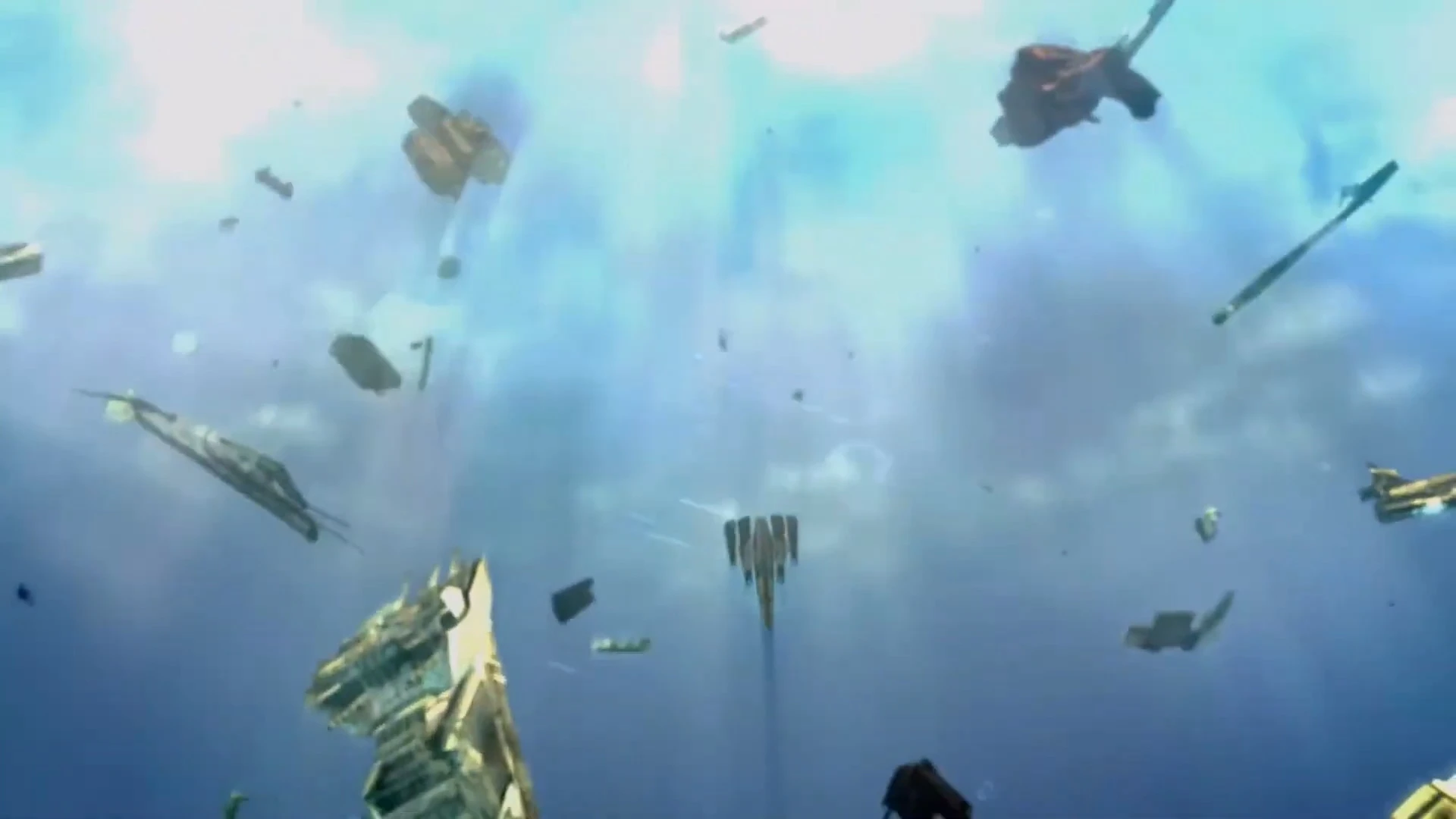
I got them all out, by the way. Many playthroughs ago now.
Everyone lived, and I understood every word of it.