


I remember a review of Dragon Age II (which I’m sure you remember was badly received) commenting that the game’s theme was an obvious step down from the grandeur of the theme from Dragon Age: Origins. Smaller stakes, smaller map, smaller hero. I hadn’t made that observation myself, so the line stuck with me.
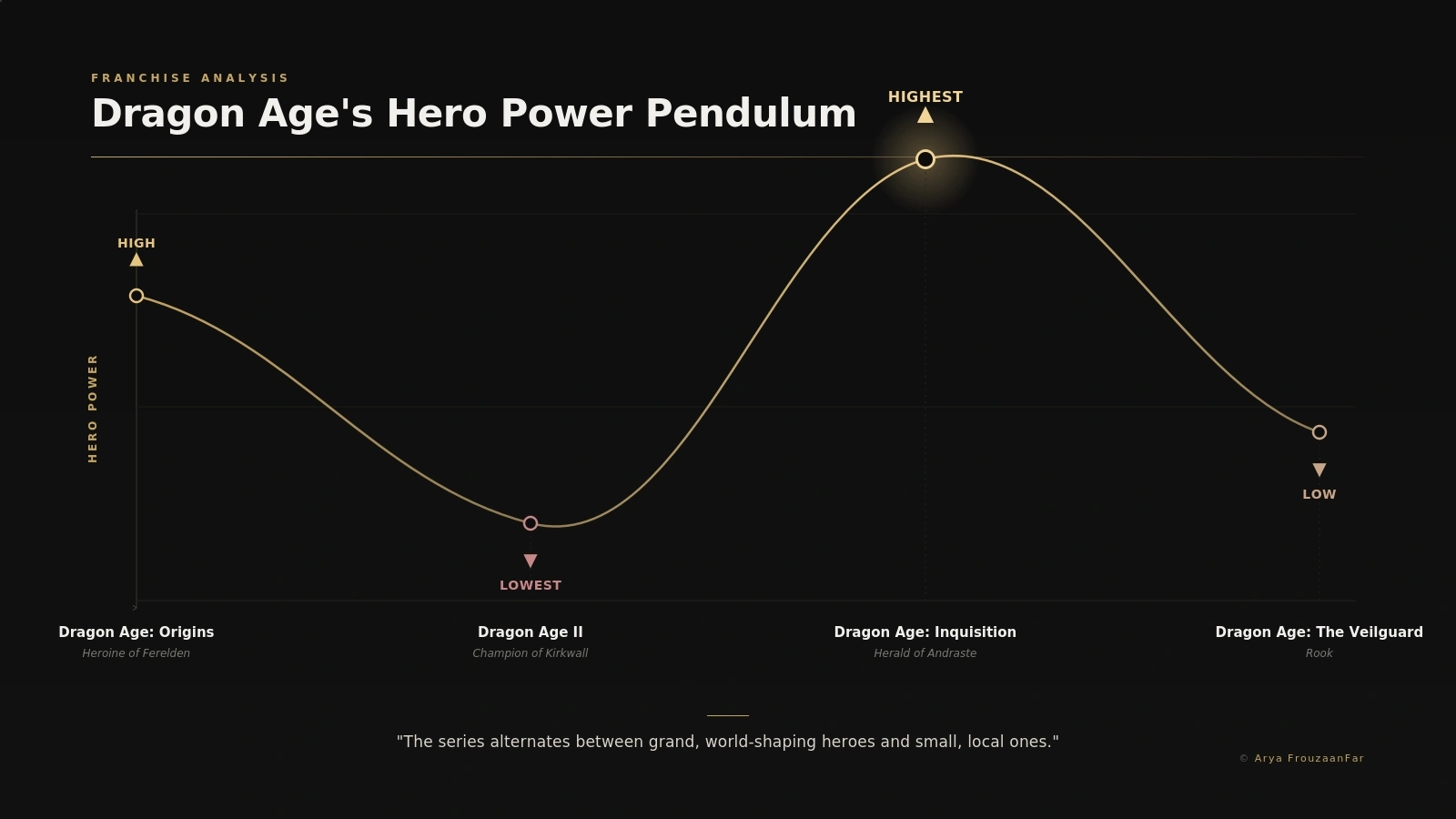
Then, the other day, I was in my third replay of Dragon Age: Inquisition and it hit me: that “step down” wasn’t a one-off stumble. There’s an up-and-down pattern in how much power Dragon Age heroes get. The series has been swinging a pendulum for fifteen years: grand, intimate, grander, and intimate again. And I guess that once you see it, you can’t unsee it.
Let’s go through it in more detail, and then to why I think this cycle exists. I’ll stick to BioWare’s own canon. Heavy spoilers ahead for all four games!
Dragon Age Origins: Hope for All of Ferelden
Ah, where it all began. No matter which origin or class you choose, you always end up one of the last Grey Wardens in Ferelden during a Blight. It’s just horrendous. The Ferelden king is dead, the army is in pieces, the man who recruited you is gone, and the darkspawn horde has a literal dragon-god at its head.
Look at the size of the job description. You’re not solving a problem; you’re solving the problem, the one the entire setting is named after. You dust off ancient treaties and personally rebuild an alliance of elves, dwarves, and men. You walk into the Landsmeet and decide who sits on the Ferelden throne. And at the end, someone has to die killing the Archdemon, and the story looks straight at you.
The Warden’s power isn’t flashy though. No glowing hand, no divine title, just sheer scope. One person becomes the hinge on which an entire nation turns, and the game never lets you forget it. I can’t forget it years after. The pendulum starts high.
Dragon Age II: Hero, For Just a City
And then BioWare took all of that away.
Here’s my old gripe with DAII, the same one that review had: why, why does it all happen in a single city?! You play Hawke, a refugee who flees the very Blight you just ended, lands in Kirkwall, and then… stays there. For years. The Deep Roads expedition is the farthest you ever get from your front door.
Hawke’s power ceiling is written right into the title they earn: Champion of Kirkwall. Not Ferelden, not Thedas, one city. You go from deciding the fate of a country to mediating between a paranoid templar commander and an increasingly twitchy apostate roommate.
Now, years later, I’ll admit the intimacy was the point. DAII is a character study wearing an RPG’s clothes. It’s a story about how one family and one city slowly come apart, told at a scale where you actually know the people involved. And the ending pulls a clever trick: the smallest game in the series lights the fuse for the mage-templar war that engulfs the whole continent. Tiny hero, seismic consequences.
But the fact remains: the pendulum swung hard toward small. (It didn’t help that the game was famously built in under two years. The small scope wasn’t only an artistic choice, it was a production reality.)
Dragon Age Inquisition: Force to Be Reckoned With
Then came the correction. And what a correction!
The Inquisitor doesn’t just get power; they get every kind of power the setting can dispense:
- Divine flavor: You survive an explosion that kills the heads of the Chantry, mages, and templars, walk out of the Fade with a glowing mark on your hand, and half of Thedas starts calling you the Herald of Andraste. I got goosebumps writing this!
- Political flavor: You sit in judgment of nobles, swing the succession of Orlais at the Winter Palace, and command a fortress with your own army, spymaster, and diplomat.
- Personal flavor: You close tears in reality by raising your hand.
My favorite illustration is the one that made me notice the pattern in the first place. What do you do when you find out rogue Grey Wardens are all holed up in Adamant Fortress, an ancient stronghold that has never fallen while defended by said Wardens?
That’s right: you lay siege to it! And you win. Then, you fall into the Fade itself and walk out yet again. That’s how powerful the Inquisitor was: the legendary Grey Warden order from game one is now a problem you solve on a Tuesday.
The pendulum didn’t just swing back up. It swung past Origins entirely.
Dragon Age The Veilguard: Not the Chosen One
And then we go to Rook, and the swing back down.
On paper, the stakes of The Veilguard are the biggest in the series: ancient elven gods loose upon the world, the Dread Wolf on their tails, all of Thedas in the balance. But look at who’s holding the controller’s end of it: Rook is nobody. No divine mark, no prophetic title, no army. You’re a competent professional hand-picked by Varric, leading a crew of eight-ish people out of a lighthouse. Your superpower is project management.
The game is strangely honest about this smallness. Let’s face it, no one even utters the word “Veilguard” in the game. The Inquisitor got heralded in chapels while Rook’s team barely gets a name thanks to an epilogue slide. Where the Inquisitor judged prisoners from a throne, Rook’s job between missions is making coffee-adjacent small talk and keeping the group’s morale from collapsing. It’s DAII’s philosophy wearing Inquisition’s budget: world-ending threat, human-sized hero.
So, there it is, plotted out: huge, small, huger, small again. A pendulum with a fifteen-year period.
Why Does the Pendulum Swing?
I have three theories for this power pendulum, and I think all of them are a little bit true.
The Correction Theory
Each game overcorrects for the criticism of the last one. DAII’s city-sized story is essentially “Origins, but faster and cheaper.” Then, Inquisition answered the backlash with the biggest possible everything. And after Inquisition was accused of power-fantasy bloat by reviewers and gamers alike, Veilguard shrank the hero back down. BioWare may be in a perpetual argument with its own reviews.
The Stakes Theory
This is the narrative-design explanation, and the one I find most elegant: power and tension are enemies. Once your protagonist commands armies and walks out of the Fade, where’s the next story supposed to go? The only direction that restores drama is down.
Shrinking the hero is how the series re-arms its own stakes. Superman stories have wrestled with this forever, and Dragon Age just does it on a per-game cycle.
The Boring Theory
It’s just production reality. DAII got less than two years; Veilguard survived a famously long, rebooted development. Scope isn’t only a creative dial; it’s also deeply entrenched in the production schedule. I put this last because it’s the least fun!
One cheeky observation before we wrap: notice which games were beloved at launch and which were divisive.
- Origins: Adored
- DAII: Divisive
- Inquisition: Game of the Year
- Veilguard: Divisive
The audience, it seems, keeps voting for the upswings. We have two data points per column, so let’s not build a religion on it. But if I were a betting person, I’d say the pattern predicts Dragon Age 5 stars a full-blown chosen one. Demigod protagonist against the Executors, mark my words. (And if I’m wrong, this paragraph never existed.)
TL; DR
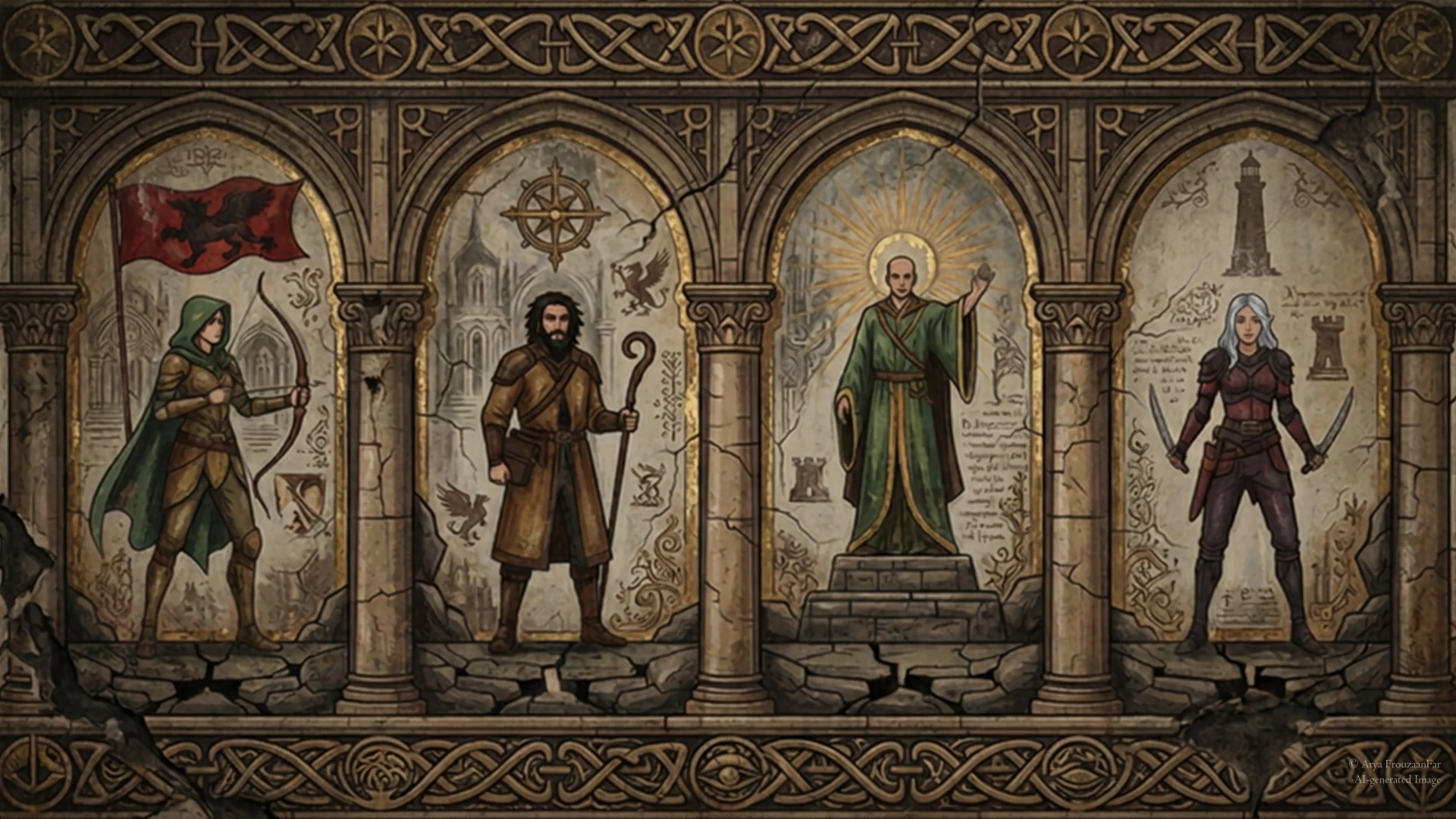
- Dragon Age protagonists follow a pendulum of power. The series alternates between grand, world-shaping heroes and small, local ones.
- Origins: One of the last Grey Wardens. Savior of a nation, kingmaker, Blight-ender. High.
- DAII: Hawke, Champion of exactly one city, whose small story accidentally ignites a continental war. Low.
- Inquisition: The Herald of Andraste: armies, thrones, sieges of infallible fortresses, one or two strolls through the Fade. Highest.
- Veilguard: Rook, an explicitly ordinary team lead whose faction name nobody even says out loud. Low.
- Why? I have three theories. One, each game corrects the last one’s criticism. Two, shrinking the hero restores stakes. And three, sometimes scope is just what the development schedule allows.
- If the pattern holds, the next hero will be a demigod. You heard it here first!
Final Word
I don’t think anyone at BioWare sat down and planned a power pendulum. Patterns like this usually emerge from a studio arguing with itself across a decade and a half with every game as a rebuttal to the one before. But that’s exactly why I find it fascinating: it’s the studio’s learning process, fossilized in canon.
And honestly? I’ve come around to the downswings. That’s the reason I believe there will be a fifth game, even after the Veilguard outrage. The small heroes are where Dragon Age remembers that Thedas is made of people, not stakes. I just needed fifteen years and one siege of Adamant to notice.